
Saudi Arabia & UAE: 2026 Budget Guide
Planning a budget Europe trip from Saudi Arabia or the UAE involves costs that many general Europe guides do not explain clearly. Your departure airport matters, but so do your passport nationality, Schengen visa requirements, the new Entry/Exit System, upcoming ETIAS rules, and the large price difference between cities such as Krakow, Budapest, Paris, and Zurich.
This guide uses official 2026 visa and border information together with current travel-cost benchmarks to build a more realistic GCC-focused budget. It also explains how to plan for halal food and prayer facilities without assuming that every restaurant or transport hub provides them.
Pricing Methodology: Fixed visa and border-policy information was checked against official European Union sources in August 2026. Airfares are date-stamped examples rather than guaranteed prices. City budgets are planning benchmarks based on travel-cost data updated in May 2026. SAR and AED conversions are rounded for easier planning.
How Much Does a Europe Trip from Saudi Arabia or the UAE Cost in 2026?
There is no single accurate price for a Europe trip because airfare, destination, accommodation style, season, and visa status can change the total substantially.
For a useful benchmark, current budget-traveler data puts daily spending at roughly $32 in Krakow, $51 in Budapest, $60 in Prague, $92 in Rome, $115 in Paris, and $153 in Zurich, including typical budget accommodation, food, local transport, and some activities.
That means two travelers can both take a 10-day Europe trip and end up with very different totals even before flights.
A 10-day Central European route through Budapest, Krakow, and Prague can be built on a much lower ground budget than 10 days split between Paris and Zurich.
For GCC travelers, it is, therefore, more useful to calculate the following:
Gulf airfare + visa costs, if required + daily city budget + intercity transport + contingency
rather than relying on one generic “Europe costs $X per day” figure.
RECENT POST
Saudi vs. UAE vs. GCC Residents: Who Needs a Schengen Visa?
One of the most important distinctions is this:
GCC residency does not determine whether you need a Schengen visa. Your passport nationality usually determines the visa requirement.
Saudi Arabia appears on the EU list of nationalities that require a visa for short Schengen stays, while the United Arab Emirates appears on the visa-exempt list for stays of up to 90 days in any 180-day period.
| Traveler | Short-Stay Schengen Position |
|---|
| Saudi passport holder | Schengen visa generally required |
| UAE passport holder | Visa-exempt for qualifying short stays |
| Saudi resident with another passport | The requirement depends primarily on passport nationality |
| UAE resident with another passport | The requirement depends primarily on passport nationality |


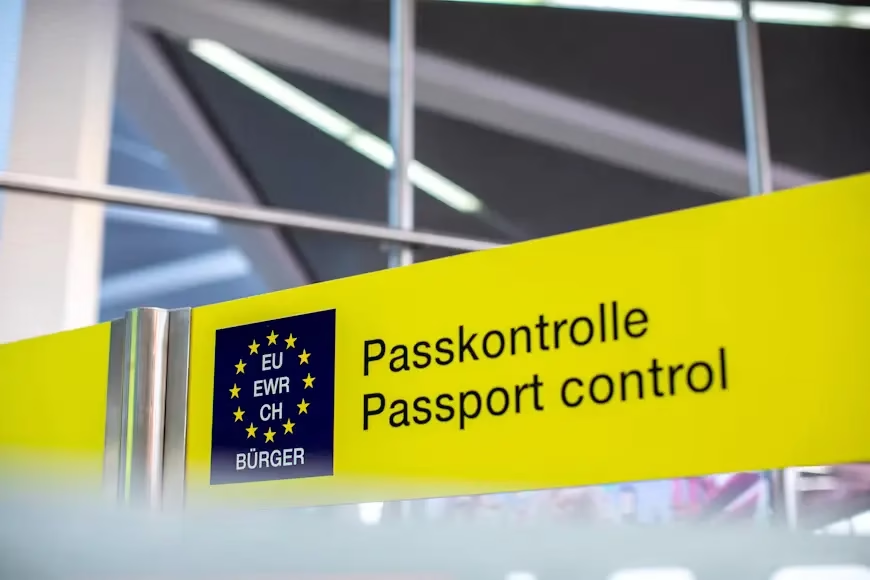

Your legal residence still matters for where you apply.
The EU advises visa applicants to apply through the consulate responsible for the country they intend to visit and, as a general rule, in the country where they are legally resident. If several Schengen countries are involved, the application normally goes to the country where the traveler will spend the longest time.
Example
A Pakistani citizen living in Dubai should not assume that UAE residency gives the same visa status as a UAE passport.
Likewise, a Saudi national living in Riyadh and an Emirati national living in Dubai can have different entry requirements even if they are taking the same holiday. This nationality-versus-residency distinction should be checked before calculating any visa budget.



Schengen Visa Costs for Saudi and GCC Residents in 2026
For nationalities that require a standard short-stay Schengen visa, the official EU application fee is:
| Applicant | Official Visa Fee |
| Adult | €90 |
| Child aged 6 to under 12 | €45 |
| Child under 6 | Visa fee normally waived |
The €90 and €45 standard fees are set in the EU Visa Code.
Do Not Treat €90 as Your Final Visa Cost
The embassy fee is only one part of the application cost.
Depending on the country you are applying to, you may also pay for:
- Visa application centre service fees
- Travel medical insurance
- Passport courier services
- Photographs or document printing
- Optional premium-centre services
The EU specifically notes that an additional service center fee may apply when an external provider collects applications on behalf of a consulate.
Travel medical insurance is also part of the standard supporting-document requirements for applicants who require a Schengen visa.
Not Every Schengen Application Uses VFS Global
Avoid assuming that every traveler in Saudi Arabia applies through VFS Global.
For example, France uses VFS Global centers for applications in Saudi Arabia, while Spain identifies BLS as its external visa application provider in Riyadh and Jeddah.
That means the final service charge can depend on the country you are visiting and the provider handling applications.
When Should You Apply?
Official EU guidance says a Schengen visa application should normally be submitted:
- No earlier than six months before travel
- At least 15 days before the intended trip
Normal processing is around 15 days, but individual applications may take up to 45 days when additional examination or documents are required.
For a leisure trip, leaving more time than the minimum is sensible because appointment availability can also affect your planning.
Does VFS Premium Service Make the Visa Faster?
No. Paying for an optional premium service does not mean the consulate will process or approve your visa faster.
VFS Global’s Saudi Arabia page for France specifically states that its optional services do not affect appointment waiting times, consular processing times, or the visa decision.
Use optional services for convenience, not as a shortcut to approval.
EES vs ETIAS: What GCC Travelers Need to Know in 2026
Two European border systems are frequently confused: EES and ETIAS.
They are not the same thing.
| Feature | EES | ETIAS |
|---|---|---|
| Full name | Entry/Exit System | European Travel Information and Authorisation System |
| Status in August 2026 | Operational | Not yet operational |
| Main purpose | Digital border entry/exit records | Pre-travel authorisation |
| Main group affected | Many non-EU short-stay travelers | Visa-exempt travelers |
| Separate online application | No standard traveler application | Yes |
| Fee | No separate ETIAS-style fee | €20 when operational |
What Is EES?
The entry/exit system became fully operational on April 10, 2026, at external Schengen border crossing points.
It records information for many non-EU nationals making short stays, including travel-document information, entry and exit data, facial images, and fingerprints.
For GCC travelers, this means European border processing has changed even before ETIAS begins.
What Is ETIAS?
As of August 9, 2026, ETIAS is not yet operating.
The European Union says it is expected to start in the last quarter of 2026, and the exact launch date will be announced later. Travelers do not need to apply yet.
Once operational, ETIAS will apply to eligible visa-exempt travelers, which includes UAE passport holders.
The application fee is set at €20, although some categories, including applicants under 18 and over 70, are exempt from paying the fee.
An approved ETIAS travel authorization will generally remain valid for up to three years or until the linked passport expires, whichever happens first.
ETIAS will also be followed by transitional and grace periods lasting at least 12 months in total, so its rollout should not be described as an instant one-day change for every eligible traveler.
Does a Saudi Passport Holder Need ETIAS Instead of a Visa?
No. ETIAS is designed for visa-exempt nationalities.
Saudi passport holders currently remain subject to the Schengen visa requirement, so ETIAS does not replace the visa for them.
Which Gulf Airport Has the Cheapest Flights to Europe?
There is no Gulf airport that is consistently the cheapest for every European trip.
The cheapest departure point changes according to the following:
Destination
Travel dates
Direct versus connecting flight
Airline
Baggage allowance
Refund or change rules
Seasonal routes
Airport transfer costs
A better strategy is to compare Riyadh (RUH), Jeddah (JED), Dammam (DMM), Dubai (DXB), Abu Dhabi (AUH), and Sharjah (SHJ) when reaching those airports is practical for you.
August 2026 Fare Snapshot: Same Airline, Same European City
To show why it is risky to declare one airport the permanent winner, here is a date-stamped snapshot from Turkish Airlines’ route pages for October 2026 round-trip economy starting fares from Budapest:
| Route | Starting Fare Shown | Approx. USD Equivalent* |
|---|---|---|
| Riyadh → Budapest | SAR 3,096 | ~$826 |
| Jeddah → Budapest | SAR 3,196 | ~$852 |
| Dubai → Budapest | AED 2,910 | ~$792 |
The airline warns that displayed fares are dynamic and may no longer be available when a traveler books.
*USD equivalents are included only for easier comparison.
Saudi Arabia maintains the riyal at approximately SAR 3.75 per US dollar, while the UAE dirham operates around AED 3.672–3.673 per US dollar.
This snapshot does not prove that Dubai is always cheapest.
It shows why the correct answer is
Compare the same destination, dates, baggage rules, and cabin type across several Gulf airports before booking.
What About Low-Cost Airlines?
Budget airline fares can be much lower than full-service fares, but the headline price may exclude the following:
Checked baggage
Seat selection
Meals
Airport transfers
Flexible changes
Compare the final checkout price, not only the first fare shown.
How Far Ahead Should You Book Flights?
There is no reliable universal rule that says Sunday is always the cheapest booking day or that every Gulf-Europe flight should be bought exactly five or six weeks ahead.
Airline pricing changes by route and demand.
A safer strategy is to:
Start monitoring your route well before travel.
Set price alerts.
Check nearby travel dates.
Compare several Gulf departure airports.
Compare total fares after baggage.
Recheck the airline’s own website before paying.
Treat any “best weekday to book” claim as a historical trend, not a guarantee.
Daily Europe Budget by City: GCC-Friendly Comparison
Regional labels such as “Eastern Europe costs $80 per day” are too broad.
City-level comparisons are much more useful.
Recent 2026 travel-budget data gives the following budget traveler benchmarks per person per day:
| City | USD | Approx. SAR | Approx. AED |
|---|---|---|---|
| Krakow | $32 | SAR 120 | AED 118 |
| Budapest | $51 | SAR 191 | AED 187 |
| Prague | $60 | SAR 225 | AED 220 |
| Rome | $92 | SAR 345 | AED 338 |
| Paris | $115 | SAR 431 | AED 422 |
| Zurich | $153 | SAR 574 | AED 562 |
These benchmarks are based on budget-traveler estimates covering accommodation, affordable meals, local transportation, and activities rather than Gulf airfare or visa expenses.
The SAR and AED figures are rounded using the currencies’ USD pegs.
What Can 300 SAR or 300 AED Per Day Buy?
This comparison makes the cost difference easier to understand for GCC travelers.
A daily budget around SAR 300 or AED 300 is above the cited budget benchmark for the following:
Krakow
Budapest
Prague
It becomes tighter in the following:
Rome
Paris
And it falls well below the benchmark for the following:
Zurich
This does not mean every traveler will spend those exact amounts. Hotel dates, paid attractions, room type, and eating habits can easily move your total.
The value of the table is comparison, not a guaranteed quote.
Why City Choice Matters More Than “East vs West”
Europe has large price differences, but a universal statement such as “Eastern Europe is always 40–50% cheaper” oversimplifies the market.
Even within one region, capital cities, resort areas, event weekends, and peak seasons can behave differently.
For budget planning, compare your actual cities instead of relying on one Eastern-versus-Western-Europe percentage.
A route through Krakow, Budapest, and Prague will usually give you more room in a fixed budget than a route centered on Paris and Zurich, as the city benchmarks above demonstrate.
Where to Stay Without Overpaying
Do not assume a hostel, guesthouse, hotel chain, or direct booking website will always be cheaper.
Instead, compare the final price for the same room and cancellation conditions.
Check:
Room type
Private versus shared bathroom
City or tourist taxes
Breakfast
Cancellation terms
Distance from public transport
Baggage storage
Final payment amount
A property outside the city center may look cheaper but become less attractive once you add daily transport.
Likewise, a room including breakfast may be more economical than a slightly cheaper room that requires buying an additional meal every morning.
Direct Booking vs Booking Platforms
Check both.
A hotel may offer a better direct rate, while an online booking platform may sometimes have a member price or stronger cancellation conditions.
The correct comparison is the all-in rate for the same stay, not a rule that one channel is always cheaper.
Halal Food in Europe: How to Check Properly
Major European cities can offer a wide range of Muslim-friendly dining options, but do not assume a restaurant is halal simply because it serves Turkish, Lebanese, Moroccan, Pakistani, or Middle Eastern food.
Cuisine and halal status are not the same thing.
Before ordering meat, check:
Whether the restaurant explicitly states that its meat is halal.
Whether any halal certification is displayed and current.
Whether staff can clearly explain meat sourcing.
Whether alcohol or non-halal products are prepared using shared equipment, if that matters to your personal requirements.
Turkish, Arab, South Asian, and North African restaurants can be useful places to start searching, but the restaurant’s own halal information should be verified.
Build Halal Stops Into the route before you fly.
Before booking accommodation:
Search for halal restaurants nearby.
Check mosque locations.
Save several food options offline.
Check restaurant opening hours.
Keep a backup supermarket or simple meal option.
This is particularly useful when visiting smaller cities where halal options may be less concentrated than in major capitals.
Prayer-Friendly Travel in Europe
Prayer facilities vary by airport and station, so avoid assuming that every European transport hub provides a dedicated prayer room.
Some major airports do provide them.
For example, Frankfurt Airport officially lists Muslim prayer rooms in its terminals, including facilities available throughout the day.
Amsterdam Schiphol operates a non-denominational, interfaith meditation center after security that is open 24/7 and can be used for prayer or quiet reflection.
Before traveling:
Check the airport’s official terminal map.
Search for “prayer room,” “multi-faith room,” or “meditation center.”
Check whether the facility is before or after security.
Save nearby mosque locations.
Keep prayer times available offline.
Do not rely only on old travel blogs because airport facilities and terminal locations can change.
7 Ways to Cut Your Europe Trip Cost from the Gulf
1. Compare Several Gulf Departure Airports
Do not automatically book from your home airport.
Check nearby alternatives when the ground transfer is realistic, but calculate the transfer cost before deciding that another airport is cheaper.
2. Start the Schengen Process Early
Applications can generally be submitted up to six months before travel.
Do not pay for optional premium-center services because you believe they guarantee faster consular processing; they do not.
3. Choose Cities Before Setting Your Daily Budget
A fixed daily allowance can work very differently in Krakow and Zurich.
Build your trip around actual city-level costs rather than a generic “Europe average.”
4. Compare Intercity Bus and Rail Prices
For a Central Europe route, overland travel can be inexpensive when booked sensibly.
Current FlixBus route pages, for example, have shown starting fares around $23.98 from Budapest to Krakow, around $19.98 from Krakow to Prague, and around $39.98 from Prague back to Budapest. Fares remain dynamic and depend on departure time and demand.
5. Compare Accommodation by Final Price
Include taxes, breakfast, cancellation terms, and transport to the city center.
A lower nightly price does not always mean a lower total trip cost.
6. Travel Outside the Most Expensive Peak Dates
Summer can raise accommodation demand in popular destinations.
Current city-budget resources for Budapest, Prague, Paris, and Rome also advise that peak summer periods tend to be more expensive than shoulder or lower seasons.
April–May and September–October can therefore be useful periods to compare, although weather, school holidays, festivals, and individual routes still affect pricing.
7. Separate Fixed Costs From Variable Costs
Your spreadsheet should have separate lines for:
Fixed or semi-fixed costs
Visa fee
Insurance
Flights
Intercity tickets
Daily costs
Accommodation
Food
Local transport
Attractions
Contingency
Unexpected transport
Baggage charges
Price changes
Emergency purchases
This makes the budget much easier to adjust.
Sample 10-Day Central Europe Budget from the Gulf
Here is a more transparent example than giving one unsupported “all-in Europe price.”
Route
Budapest: 4 days
Krakow: 3 days
Prague: 3 days
The fourth Budapest day allows the traveler to return to Budapest before flying home.
Step 1: City Spending Benchmark
| City | Days | Budget Benchmark | Estimated Cost |
|---|---|---|---|
| Budapest | 4 | $51/day | $204 |
| Krakow | 3 | $32/day | $96 |
| Prague | 3 | $60/day | $180 |
| City subtotal | 10 | $480 |
The daily benchmarks come from travel-cost data updated in May 2026.
Step 2: Intercity Transport
Using currently displayed FlixBus starting prices as a planning reference:
| Route | Starting Price |
|---|---|
| Budapest → Krakow | $23.98 |
| Krakow → Prague | $19.98 |
| Prague → Budapest | $39.98 |
| Intercity subtotal | $83.94 |
Step 3: Ground Budget Before Flights
City spending:
$480
Intercity transport:
$83.94
Ground subtotal:
$563.94
Adding a 15% planning buffer gives approximately the following:
$649
Using the USD currency pegs, which are roughly
SAR 2,432
AED 2,382
The 15% buffer is a budgeting choice, not a published European fee.
Step 4: Add Gulf Airfare
For illustration, Turkish Airlines’ August 2026 route pages showed October round-trip Budapest starting fares of
Riyadh → Budapest: from SAR 3,096
Jeddah → Budapest: from SAR 3,196
Dubai → Budapest: from AED 2,910
These fares are dynamic and are used only as a dated planning snapshot.
Example: Saudi Passport Holder Departing Riyadh
Approximate ground budget with buffer:
SAR 2,432
Example airline starting fare:
SAR 3,096
Subtotal:
SAR 5,528
Then add:
€90 Schengen visa fee
Visa center service fee
Required travel medical insurance
Any optional baggage or seat charges
Using a recent Saudi Central Bank EUR rate as a rough conversion reference, €90 is around the high-SAR-300 range, although the EUR/SAR rate changes.
That puts this specific scenario at roughly SAR 5,900 before variable visa center, insurance, and optional airline charges.
This is a planning example, not a guaranteed package price.
Example: UAE Passport Holder Departing Dubai
Approximate ground budget with buffer:
AED 2,382
Example airline starting fare:
AED 2,910
Approximate total:
AED 5,292
A UAE passport holder does not currently need a standard short-stay Schengen visa, and ETIAS is not yet operational as of August 9, 2026.
Travel insurance and airline extras should still be budgeted according to the traveler’s needs and booking conditions.
How Much Would the Same Trip Cost in Western Europe?
The destination mix can change the budget dramatically.
Using current budget-traveler benchmarks:
10 days at a Krakow-style $32/day benchmark = about $320 before Gulf flights.
10 days at a Paris-style $115/day benchmark = about $1,150.
10 days at a Zurich-style $153/day benchmark = about $1,530.
This is why a single statement such as “a 10-day Europe holiday costs $2,000” is not precise enough.
The countries and cities you choose can matter as much as the length of the trip.
A Better Europe Budget Formula for GCC Travelers
Use this simple calculation:
Total Trip Budget = Gulf Flights + Visa/Entry Costs + City Spending + Intercity Travel + Contingency
For a Saudi passport holder, that may include the Schengen visa and application-related costs.
For a UAE passport holder, the visa line may currently be zero for a qualifying short stay, while future ETIAS costs should only be added once the system becomes operational and applies to the traveler.
This method prevents visa status and airfare from being mixed into vague daily averages.
Frequently Asked Questions
Is ETIAS required for UAE passport holders right now?
How much will ETIAS cost?
What is EES, and is it already active?
Which Gulf airport has the cheapest flights to Europe?
Is Jeddah always cheaper than Riyadh for Europe?
Is halal food easy to find in Europe?
Do UAE citizens need a Schengen visa?
Do Saudi citizens need a Schengen visa in 2026?
Does GCC residency mean I do not need a Schengen visa?
Are there prayer rooms at European airports?
What is the cheapest time to visit Europe from the Gulf?
Does VFS Premium Lounge make a Schengen visa faster?
Final Budget Checklist
Before paying for your trip, verify each of these separately:
- Passport nationality and Schengen visa status
- Visa application provider for your destination
- Current embassy and service center fees
- Travel medical insurance requirements
- EES and ETIAS status
- Gulf departure airport options
- Final airfare including baggage
- Daily budget for each specific city
- Intercity train or bus fares
- Hotel taxes and cancellation rules
- Verified halal food options
- Mosque or airport prayer facilities
- Emergency and contingency money
Sources and Research Notes
This guide prioritizes official sources for immigration, border rules, currency policy, and airport facilities.
Key sources include:
- European Commission guidance on applying for a Schengen visa.
- EU legislation setting the €90 adult and €45 child Schengen visa fees.
- EU visa-nationality regulations identifying Saudi Arabia as visa-required and the UAE as visa-exempt for qualifying short stays.
- Official ETIAS information confirming its planned Q4 2026 launch and €20 fee.
- European Commission confirmation that EES became fully operational on April 10, 2026.
- The Saudi Central Bank and the Central Bank of the UAE exchange-rate information used for rounded GCC currency conversions.
- Travel-cost benchmarks updated in May 2026 for Krakow, Budapest, Prague, Rome, Paris, and Zurich.
- Official airport information for Muslim and multi-faith prayer facilities at Frankfurt and Amsterdam Schiphol.
Important: Flight prices, accommodation prices, exchange rates against non-pegged currencies, visa center service charges, and transport fares can change after publication. Recheck all variable costs for your actual travel dates before booking.